Two new features in DTU Findit: AI-assisted and semantic search
Get assistance for your literature search
Wednesday 29 April 2026
A new AI assistant in DTU Findit can help you expand a subject search with related concepts – currently available in a beta test version.
The new semantic search retrieves literature based on the meaning of the words in your search, rather than, as is normally the case, relying solely on exact matches of the words themselves.
The two new search methods can be used individually or in combination.
AI-Assisted search
– search using variants of keywords and related concepts
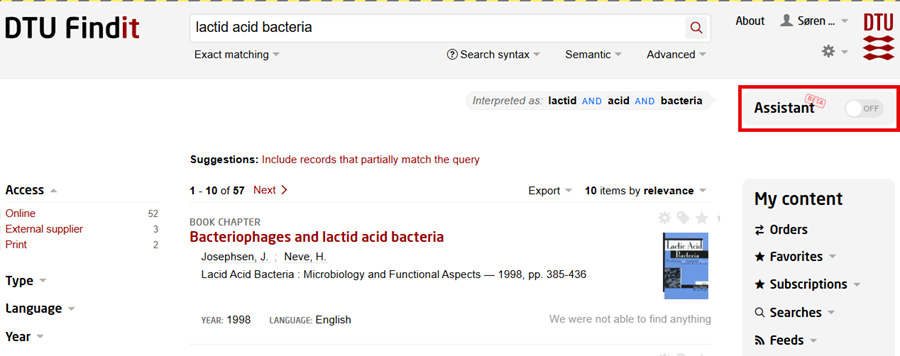
DTU Library has implemented an AI assistant (still in beta) in DTU Findit, which you can enable to support your search. Among other things, the assistant attempts to identify whether you are searching for a subject, a title, or an author, and you can then refine your search from there.
For subject searches, the assistant can suggest expanding the search with keyword variants and related concepts, so that relevant scientific literature using different terminology is also included in the results.
You can, of course, choose to accept or reject the assistant’s suggestions before executing the search.
Example of an AI-assisted subject search: When searching for “lactic acid bacteria”, the assistant may suggest related concepts such as “lactate”, “probiotic”, “lactobacillus”, and “2-hydroxypropanoic acid”.
AI-assisted search can be activated on the right-hand side below the search box.
Semantic search
– search by meaning rather than exact words
Semantic search retrieves literature based on what a word means, not only on whether the word appears exactly as written in the text. In this way, semantic search sorts search results by concepts rather than exact matches.
This search method can be used, for example, when different technical terms are used for the same or related concepts. Traditional subject-term searching can still be used at the same time to filter by very specific terms.
Features
Search for content with the same meaning
Search without having to specify all possible synonyms, abbreviations, spelling variants, etc.
Search using longer text passages, for example an abstract or a research question
The search can be combined with the standard, word-based search
Example of semantic search: If you search for “water contamination”, you may also retrieve material about “ocean pollution”, because the topics are conceptually related – even though the words are not the same.
Semantic search is available below the search box in DTU Findit.
DTU Findit
DTU Findit is DTU's online library service. Here you can search for all the literature that DTU Library provides access to which covers the university's research areas, i.e., natural, and technical sciences. With DTU Findit you search across the library's collection of books and journals, articles and information from all the major and minor publishers - you only need to go one place to search it all. DTU Findit